Smart casual for men over 30
The dress code nobody can define, explained by its boundaries instead. Three rules, five failures, and one outfit that covers most of the week.
Smart casual is the only dress code that gets harder with age, because the mistakes change. At 25, wearing the wrong thing reads as not having tried. At 35, it reads as having given up — and that is a much worse impression to leave in a room full of people who decide things about you.
The phrase itself is useless. It has no definition, only boundaries. So work from the boundaries.
The definition that actually helps
Smart casual means at least one structured garment, and no more than two.
Structure means: a jacket with a shoulder, a shirt with a collar and a placket, leather shoes, a coat with a lapel. Knits, tees, chinos, jeans and trainers are the unstructured side.
One structured piece on top of an otherwise casual outfit is smart casual. Zero is casual. Three or more is business, and you will look like you are on your way to a meeting you were not invited to.
Three rules that settle most decisions
One: the shoe sets the level. Leather derby, loafer or Chelsea boot pulls the whole outfit up one register. Clean minimal trainers hold it at casual. Chunky running shoes pull everything down regardless of what is above them. If you change one thing, change the shoe.
Two: tuck the shirt, leave the knit alone. A shirt is designed to be tucked; leaving it out over a structured trouser looks unfinished rather than relaxed. A knit is designed to sit at the hip; tucking it creates a bulge at the waist and a horizontal line where you least want one.
Three: no more than one pattern. One checked shirt, or one striped knit, or one textured jacket. Two patterns at this level of formality almost always read as a mistake rather than a choice.
The five failures after thirty
These are the ones that show up repeatedly, in order of how much they cost you:
A hoodie with tailored trousers. Two different languages in one outfit. The top says gym, the bottom says office, and the reader concludes you changed only half of yourself.
A blazer with shorts. Smart casual does not extend below the knee. This look works on a very specific kind of man in a very specific place, and it is not a boardroom.
Running shoes with tailoring. Not “sport luxe” — just unresolved. A grey mesh trainer under a wool trouser cancels the trouser.
A graphic tee under a structured jacket. The jacket says adult, the print says 2011. If you want a tee under a jacket, make it plain, heavy cotton, and the right length.
Sizes that were never altered. This is the biggest one and the least discussed. A $400 jacket that is a size too big looks cheaper than a $120 jacket that fits. Shoulder seam at the shoulder edge, sleeve ending at the wrist bone, trouser hemmed.
One outfit that covers most of the week
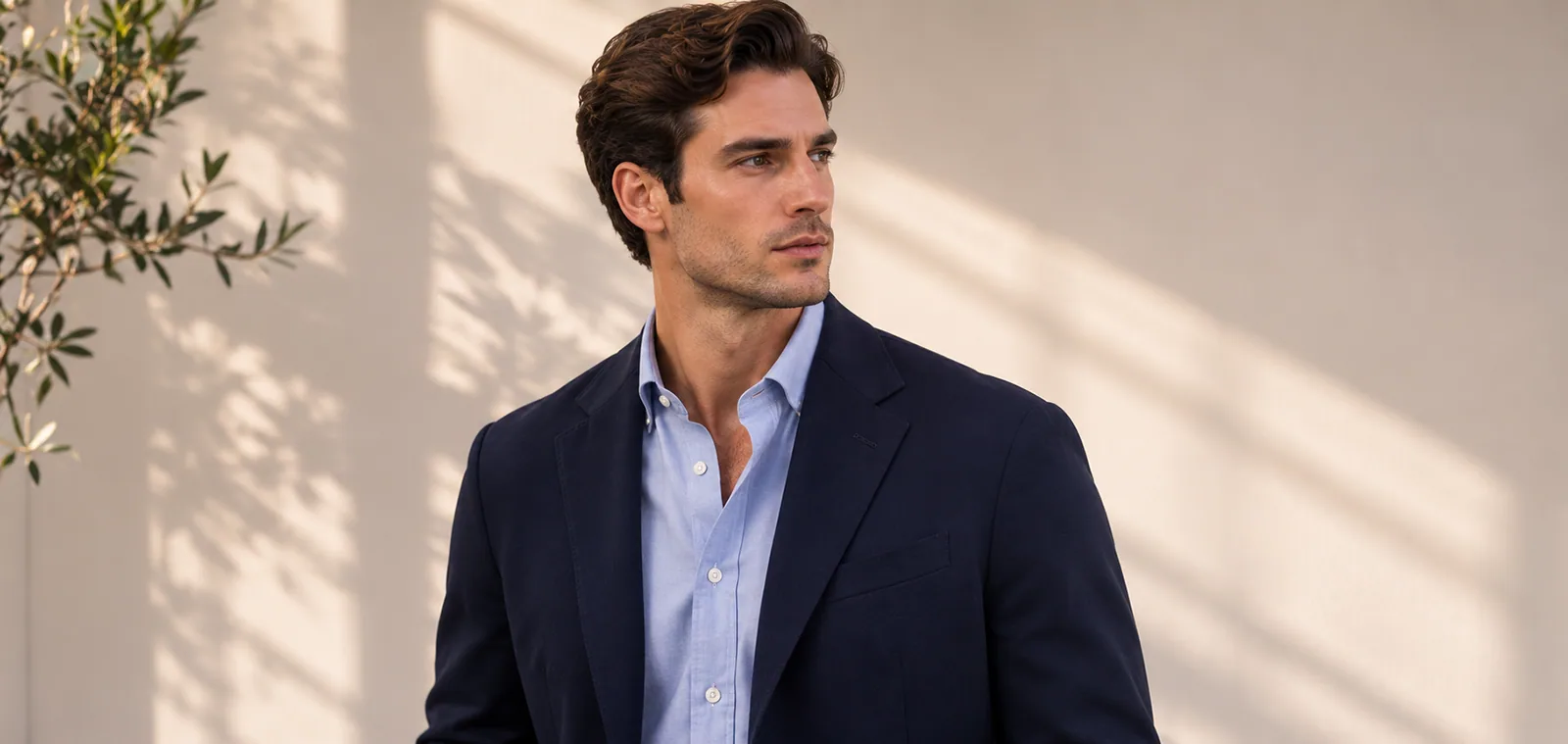
Navy unstructured blazer. White or pale blue oxford shirt, collar open, no tie. Grey or khaki chino, flat front, hemmed to a shallow break. Brown leather loafer. Belt in the same brown family as the shoe.
That is it. It works for a dinner, a client meeting that is not quite formal, a wedding rehearsal, and an office with no dress code. Swap the chino for wool trousers and it goes up a level. Swap the loafer for a clean white trainer and it goes down a level. Same three pieces, three registers.
Fabric beats logo
At this level of dressing, nobody is reading your labels. They are reading the surface: whether the shirt has a sheen, whether the knit pills, whether the jacket collapses at the shoulder.
Two cheap upgrades that outperform buying anything new: a clothes brush and a steamer. Wrinkled cotton and a fuzzy wool jacket make an expensive outfit look neglected, and the reverse is also true.
What to stop buying
Anything that requires a specific occasion you do not actually have. The wardrobe that works is the one where every piece can be worn on a Tuesday.
If you want the order to buy things in — what to replace first, what to leave alone for a year — that is a sequence problem, and it is covered here.
The other half of smart casual is not the clothes. It is whether the colours work on your skin and whether the proportions work on your frame — and neither of those can be guessed from a size label.
Read next