How to look taller
Height is fixed. Visual height is not. Eight adjustments to colour, waistline, hem and shoulder that change how tall you read in a photograph — none of them involve insoles.
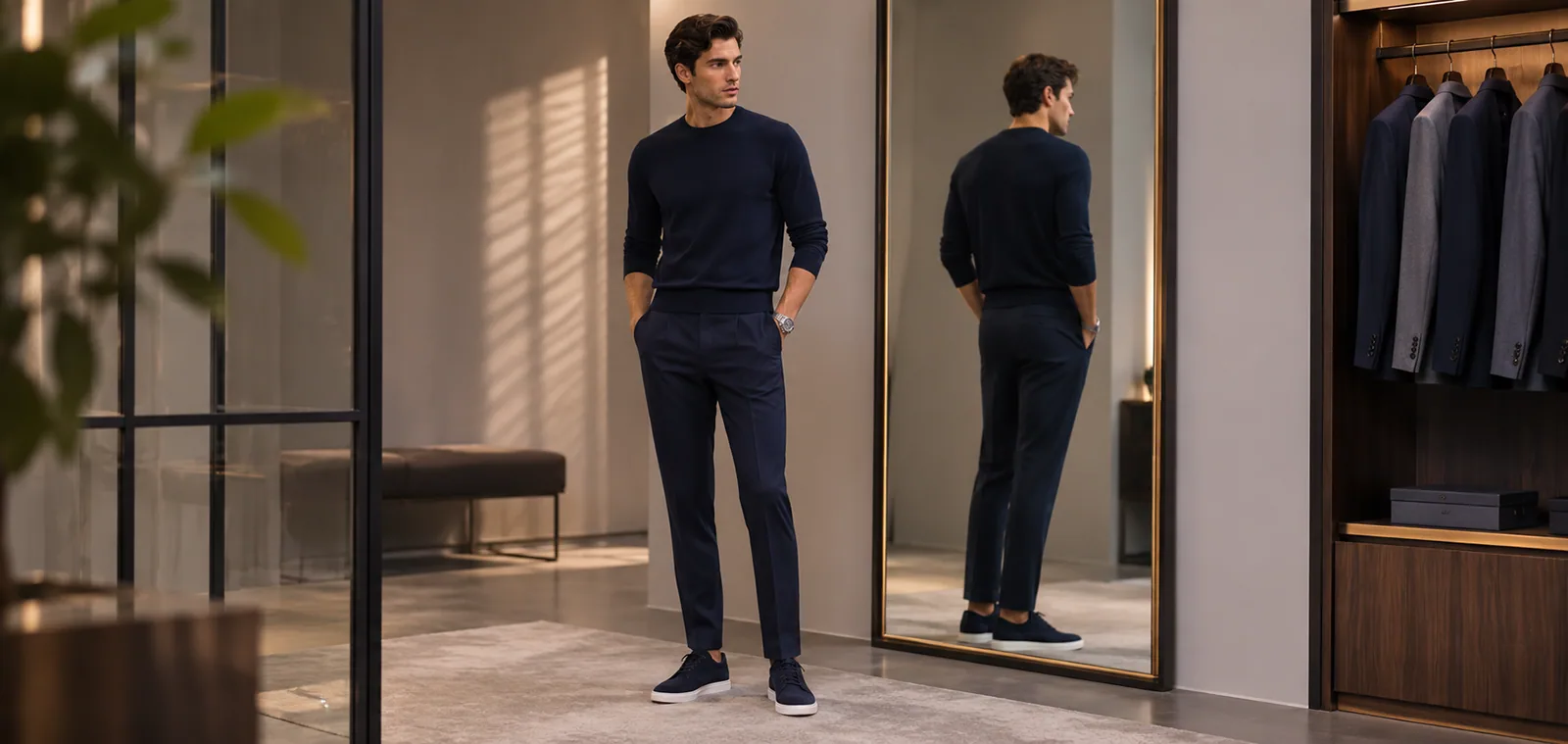
You cannot add centimetres. You can add apparent centimetres, and the difference between a man who reads as 175 cm and one who reads as 182 cm at the same actual height is almost entirely three things: how long the vertical line is, how many times it gets interrupted, and how wide the silhouette is at the point where people look.
None of that is about your body. It is about how you cut the rectangle.
What the eye is actually measuring
Nobody reads your height by looking at you against a ruler. They read it from the ratio between your head and your total outline, and from whether your body forms one continuous vertical line or several stacked horizontal blocks.
A man in a dark suit with dark shoes and dark socks looks taller than the same man in a navy jacket, grey trousers, white socks and white trainers. Identical body. Different number of interruptions.
That is the whole mechanism. Everything below is a way of applying it.
1. One colour from waist to shoe
The single highest-impact change, and it costs nothing if you already own the pieces.
Trousers, socks and shoes in the same value. Not the same exact colour — the same darkness. Charcoal trousers with black shoes and black socks reads as one long leg. Khaki trousers with white socks and white trainers reads as a leg, a gap, and a shoe.
The rule of thumb: the difference between trouser and shoe should be no more than one step on a five-step light-to-dark scale. Navy and black pass. Charcoal and brown pass. Stone and black fail.
2. Raise the waistline, not the heel
A higher rise lengthens the leg without touching your shoe. Mid-to-high rise, flat front, no pleats, sitting at the natural waist rather than under the stomach.
This is where most men lose 4 cm without noticing. A low-rise trouser worn under the belly drops the visual waist by a hand’s width, and the leg becomes whatever is left below it.
Insoles and elevator shoes solve the same problem by lying to everyone including you. They also change how you walk, which is far more noticeable than 3 cm.
3. Fix the hem before you buy anything else
A trouser that pools on the shoe creates a horizontal fold right where the eye is looking, and the leg stops there. A trouser that ends cleanly at the top of the shoe — no break, or a single shallow break — keeps the line going.
Take every pair you own to a tailor. Hemming is the cheapest alteration in menswear and the one with the largest visible return. If you have never had a pair hemmed, start with the trousers you wear most.
4. Keep the jacket short, the coat long
Two different rules, often confused.
A jacket should end at the top of the hip bone, roughly at the wrist when your arms hang. Anything past the seat adds a horizontal line across the widest part of your body and cuts the leg in half.
A coat should end just above or just below the knee — never mid-thigh, which is the length that makes almost everyone look shorter. A long overcoat worn open creates one continuous vertical panel down your front, which is the strongest lengthening tool in a wardrobe.
5. Small patterns, vertical direction
Fine stripes, narrow ribbing, small checks. The scale of a pattern reads as the scale of the body wearing it: a wide horizontal stripe or an oversized check makes the frame look wider and therefore shorter.
If you want pattern, take it in the shirt or the knit, not the trouser — and keep it under about 2 cm repeat.
6. Low-profile shoes, tapered toe
Chunky soles are sold as height. They are not. A thick sole makes the foot look large, and a large foot at the bottom of a short leg exaggerates the disproportion you were trying to hide.
A slim, low-profile shoe with a slightly tapered toe reads as a smaller foot and a longer leg. Derby, loafer, Chelsea boot — anything with a clean vamp and no visible platform.
7. Flatten the shoulder line
Drop-shoulder oversized tops are the most common 2020s mistake in this category. They slope the shoulder downward and outward, which widens the top of the body and shortens the whole figure.
You want the shoulder seam to sit at the actual edge of your shoulder, and the line to run roughly horizontal. A lightly structured jacket — even an unstructured blazer with a thin shoulder pad — does more for apparent height than any trouser.
8. The collar controls the head-to-body ratio
The smaller your head looks relative to your body, the taller you read. Collars and necklines change that ratio more than people expect.
An open collar or a shallow V lengthens the neck and keeps the head visually separate. A high turtleneck worn under a heavy jacket merges the head into the shoulders and makes the whole upper body read as a block. If your neck is short, avoid stacked collars and thick cowls.
What makes you look shorter
Collected in one place, because these are the ones that show up in photographs:
- White socks between dark trousers and dark shoes
- Trousers that pool at the ankle
- A shirt or jacket that ends below the hip
- Drop-shoulder oversized tops
- Wide horizontal stripes and large-scale checks
- Thick platform soles
- A long torso combined with a low waistband
Posture is free
Shoulders back and down, chin parallel to the floor, weight through the middle of the foot. A man who slouches loses 4 to 5 cm of apparent height and gains nothing. This is not a styling trick, it is the baseline that all the others sit on top of.
Proportion is not a matter of taste, and it is not genetic. It is a set of decisions about where lines start and stop. If you want to know which of these apply to your specific frame — shoulder width against hip width, leg length against torso — that is the first thing a structured read of your photo tells you.
Read next