Haircut for a receding hairline
Receding hair is a weight-distribution problem, not a covering-up problem. Three cuts that work, three that make it worse, and the exact words to say in the chair.
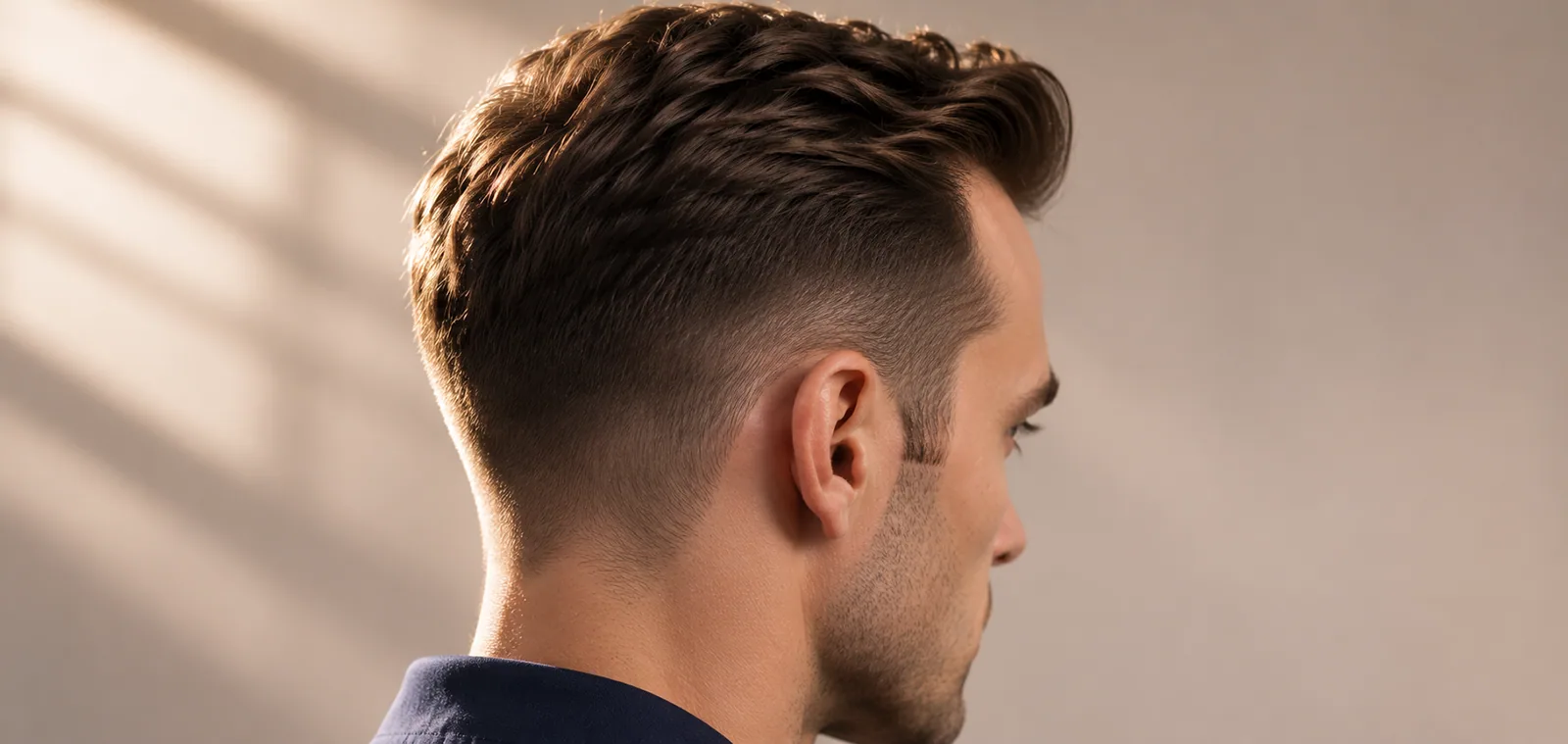
Most men respond to a receding hairline by growing the front longer, so it can be combed across. It is the instinct that makes the problem more visible, not less: the moment there is wind, or overhead light, or a photograph taken from slightly above, the whole construction is exposed.
The better question is not how do I cover this, it is where should the weight sit now that the front is no longer available.
First, work out which stage you are at
The tactics change completely depending on what you actually have. Forget the clinical scale names — three categories are enough.
Corners only. The temples have moved back but the front edge is intact and the density behind it is normal. This is the most fixable stage and the one where the wrong haircut does the most damage.
General frontal recession. The whole front edge has moved back. The corners are further back than the centre. Density behind is thinning but present.
Crown involvement. The front has receded and the top is visibly thinning, or the crown is going. At this point the haircut stops being a disguise and starts being a decision about how much to keep.
Be honest about which one you are in. A cut that works beautifully at corners-only becomes the comb-over at stage three.
Three cuts that work
1. Short taper, 2–3 cm on top
The most reliable option at any stage, and the one that requires the least maintenance. Cropped short, the “receding” edge stops being a visible boundary because everything is a similar length. What is left reads as a choice about length rather than a loss of hair.
It also makes the head shape itself the subject — which is why it suits men with a good skull shape and a strong jaw, and can look severe on men with a very narrow face.
Ask for: Number 2 fade on the sides, blended. Scissor-cut on top at 2.5 cm, textured, no hard line at the front.
2. Textured fringe worn forward
The best option for corners-only, and the one that buys the most years. Length goes at the front centre, kept broken with point-cutting, and falls forward over the receded corners. Because it is textured rather than solid, it reads as a style, not a cover-up.
Critical detail: it has to be short enough to sit up slightly, not lie flat like a curtain. Flat and solid is the exact silhouette of a comb-over.
Ask for: 4 cm at the front, point-cut so it falls forward in pieces. Keep the corners blended, don’t square the hairline.
3. Low side part
For men who need to look formal and have enough density on top. A part set low, two-thirds across, keeps the diagonal that makes a face look considered, while the low placement keeps the volume away from the temples.
It only works if the front has enough length to lie down without being held by product. If you are using gel to make it stay, you are at the wrong stage for this cut.
Ask for: Scissor over comb on the sides, not clippers. 5 cm on top, part low and to the side. Blow-dry back, no pomade.
Three that make it worse
The slick back. Pulls every hair backward and exposes the full hairline in one clean line. The more product, the more visible the recession.
The comb-over, in any form. Including the “soft” version where long front hairs are swept across a thinning patch. Under directional light it is always obvious, and it costs more authority than being bald does.
The tall quiff. Height at the crown on a receding front creates a long, narrow silhouette and draws the eye straight to the front edge. Volume belongs at the sides at this stage, not the top.
What to say in the chair
Barbers default to what they know, which is usually a squared-up hairline and a hard front edge — the two things that highlight recession most.
“Number 2 on the sides, faded. Scissor on top, about 4 cm at the front, point-cut so it falls forward in pieces. Keep the corners soft — don’t square my hairline, and don’t take the front edge back any further than it already is.”
If you say nothing else, say the last sentence.
The shave decision
There is a point where keeping hair costs more than it gives: when the top density is low enough that length no longer covers anything, when the contrast between sides and top is extreme, or when you are spending more than ten minutes a day arranging it.
A clipped head at 3 mm reads as deliberate. A thin covering reads as reluctant. If you are going to keep it, keep it short; if you are going to let it go, go properly and get the beard right instead.
What no haircut can do
A haircut changes the outline, not the density. If you want to address the loss itself, that is a medical question — minoxidil, finasteride and the rest have real evidence and real side effects, and the decision belongs with a doctor, not a barber and not a styling site.
We do not sell that, and we will not pretend a cut grows hair.
If you want to know how your hairline interacts with the rest of your face — jaw angle, face length, the proportion of the lower third — that is measurable from a single photograph, and it changes which of the three cuts above is actually right for you.

Read next