Glasses for your face shape
Frames are the only accessory that sits on the exact line people read first. How to pick a shape that corrects your outline instead of repeating it.
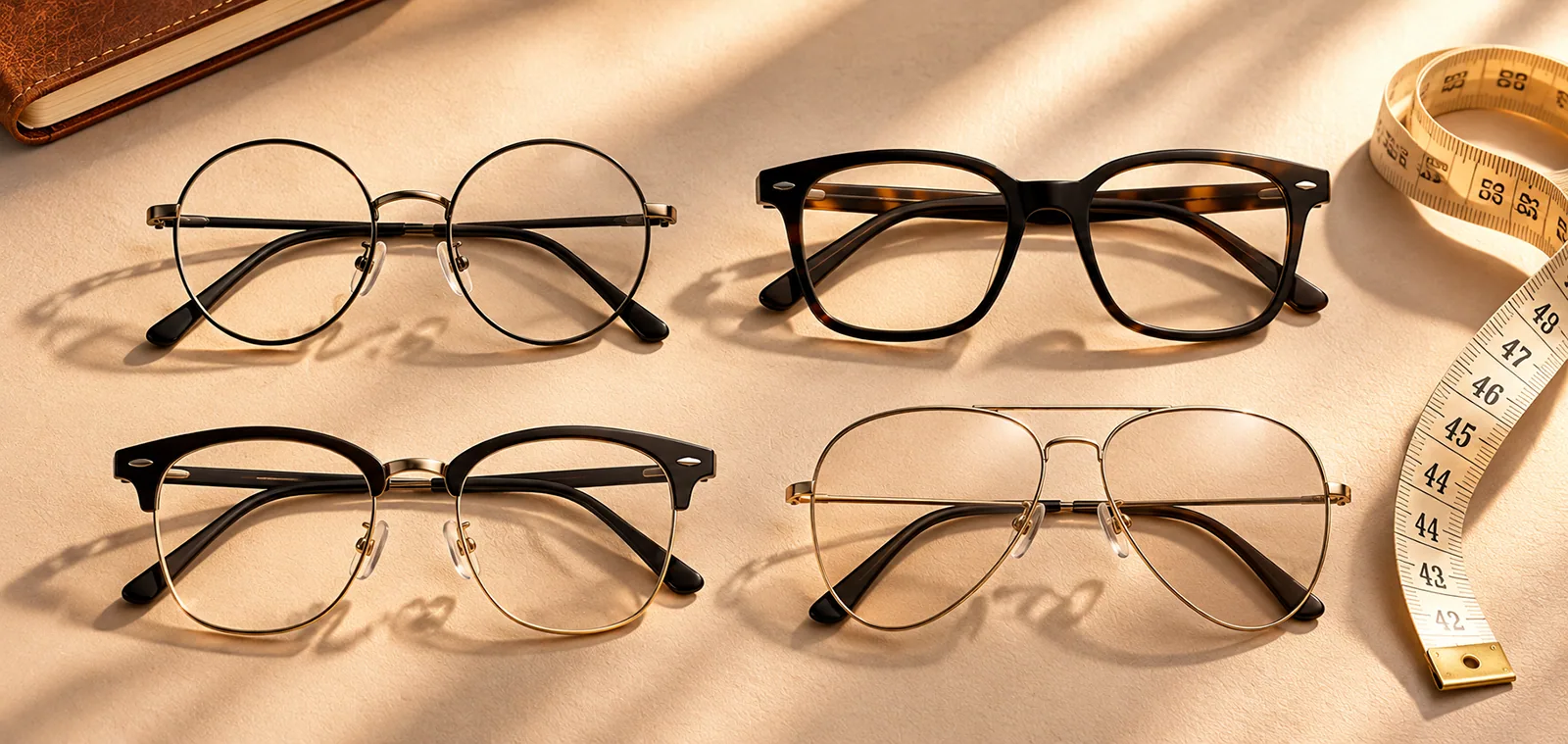
Glasses are the highest-leverage accessory a man owns, and the one most often bought by accident. They sit on the horizontal line that everyone’s eye lands on first, they stay on your face for two years, and most men choose them in eleven minutes under lighting designed to flatter the frame rather than the wearer.
There is one rule that does most of the work: the frame should contrast with your outline, not repeat it. A round face in round frames doubles the roundness. A square jaw in a square frame doubles the squareness. The frame’s job is to supply the shape your face is short of.
The second rule: width
Frame width should match your face width at the temples, or exceed it by a few millimetres. A frame narrower than your face makes the head look wider than it is, which is the reverse of what most men with wide faces are trying to achieve. A frame much wider than your face reads as borrowed.
If you are between two sizes, take the wider one. It is the more forgiving mistake.
The seven shapes
Oval
Almost anything works, which makes this the one shape where you should choose on character rather than correction. Rectangular and browline frames add the angularity an oval outline lacks. Avoid oversized round frames — they soften a face that is already soft.
Round
You want angles. Rectangular, square, or a browline with a strong top bar. The straight top edge draws a horizontal where your face has none, and the corners give structure to a soft jaw.
Avoid round and small round-metal frames. They are the single most common mistake on this face shape, and they make a full face look fuller.
Square
Soften, do not reinforce. Round, oval, or a thin metal frame with curved corners. A frame with a slightly rounded bottom edge breaks the two parallel horizontal lines of a square jaw.
Avoid thick rectangular frames and anything with a heavy, boxy browline. On a square face they look like a second jaw.
Oblong
Length is the constraint, so the frame should add width rather than height. A wider frame with a shallow lens height, or a classic wayfarer with a strong horizontal top, breaks the vertical.
Avoid narrow, tall lenses and small round frames — both make a long face read longer.
Heart
Wide forehead, narrow jaw. Choose frames that are wider at the bottom than the top: aviators, light round frames, or a bottom-heavy shape. That balances the two halves.
Avoid heavy browline frames and anything with strong top corners. They add weight to the widest part of your face.
Diamond
Cheekbones are the widest point, forehead and jaw narrower. You want frames that are widest at the brow and gently curved, plus visible detail at the temple so the eye is pulled upward.
Avoid narrow frames and strong cat-eye shapes. Anything that hugs the cheekbone emphasises it.
Triangle
Jaw widest, forehead narrower. Rimless and thin metal frames, or a shape that is wider at the top than the bottom, redraw the balance.
Avoid heavy bottom rims and small frames. Both add weight exactly where the face already carries it.
Four things that matter more than shape
Bridge fit. The frame should sit on the bridge without sliding and without pressing. If it slides, everything else about the frame is irrelevant — you will spend two years pushing it up.
Pupil position. Your eyes should sit close to the horizontal centre of the lens, not near the top edge. A frame where your pupils sit high makes you look permanently surprised.
Lens height against your eyebrows. The top rim should follow the eyebrow line, or sit just below it. A rim that cuts across the eyebrow looks like a mistake from every angle.
Temple length. Too short and the frame pinches; too long and it slides forward. This is a fitting adjustment, not a purchase decision — ask for it before you leave the shop.
Colour
Frame colour follows the same logic as clothing colour: warm undertones take tortoiseshell, olive, brown and warm metals; cool undertones take black, navy, gunmetal and silver. Crystal and clear frames sit in the middle and are the safest neutral if you are unsure.
Black is not automatically neutral. On warm skin, a heavy black frame is the hardest thing on the face.
Buying in a shop versus online
Shop lighting is warm and flattering and will make almost any frame look acceptable. Take a photo of yourself in the frame, walk to a window, and look at the photo — not the mirror. Daylight and a photograph are what your face will actually be seen in.
If you buy online, measure an existing pair you like: lens width, bridge width, temple length. Those three numbers are printed on the inside of the arm, and they are the only reliable way to order a frame that fits.
Glasses sit on the same measurement grid as your haircut — the width at your temples, the length of your face, the angle of your jaw. If you have never had those numbers, the free face shape test gives you all of them from one photo.

Read next