Six face shape mistakes
Most men classify their face from the wrong measurement, then buy haircuts for a shape they do not have. Here are the six errors that come up most, and the one check that settles each of them.
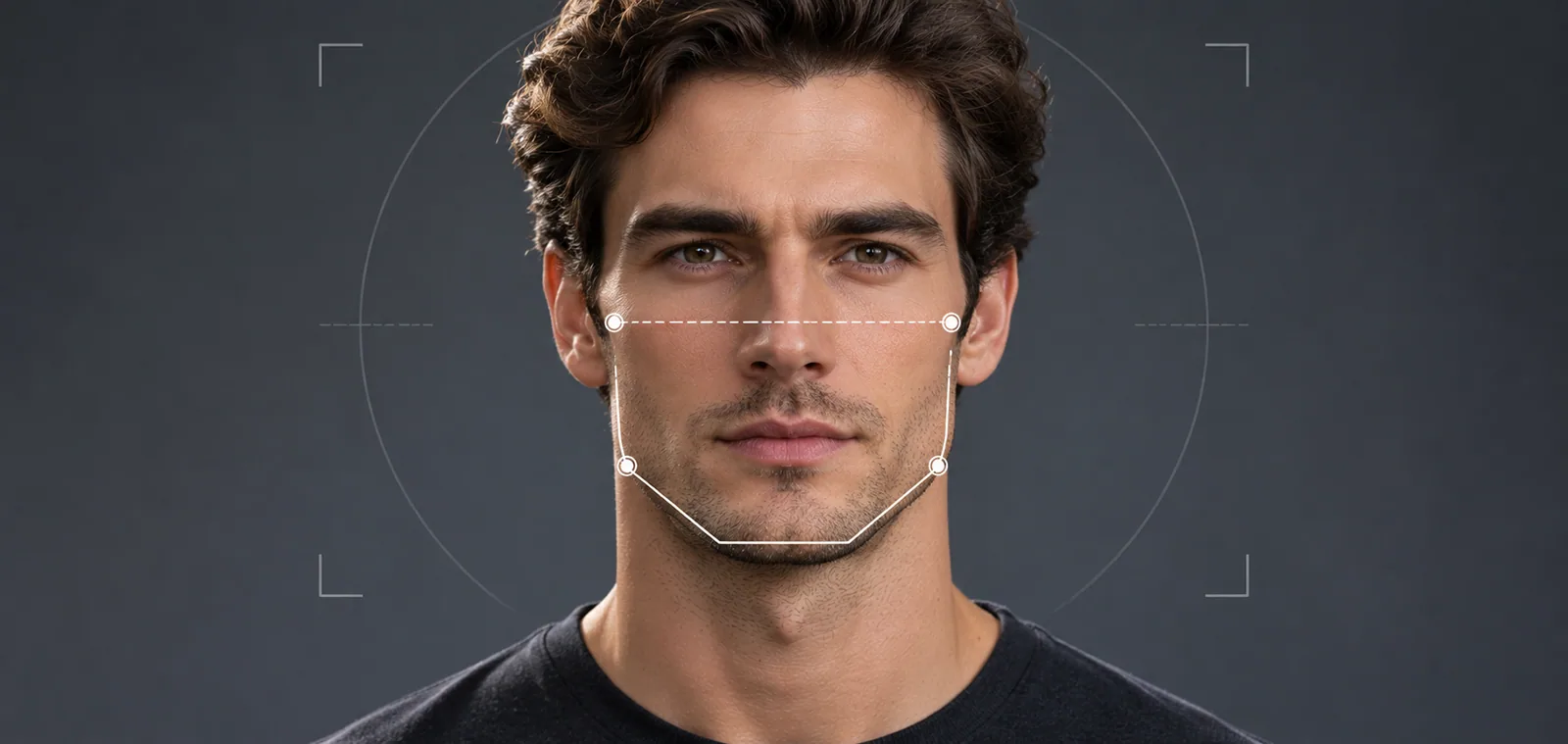
Face shape gets treated as a personality quiz — you look in a mirror, pick the name that sounds right, and move on. But the classification is geometric, and it is decidable: length against width, jaw against forehead, where the widest point sits. Get any of those wrong and every recommendation downstream is for somebody else.
These are the six mistakes that show up most often, in the order they do the most damage.
1. Judging by width-to-length alone
This is the single most common error, and it comes from the shape names themselves. “Round means as wide as it is long” and “square means as wide as it is long” are both true, which means the ratio cannot distinguish them.
What separates them is the jaw corner. Look at the point where the jaw turns upward toward the ear. If there is a visible angle — a place where the line changes direction sharply — the shape is square. If the line curves continuously with no corner, it is round.
Test it in a mirror with your head level, not tilted. A raised chin flattens the jaw and makes a round face look square to its owner, which is how people end up asking for a buzz cut that removes the only height they had.
2. Confusing oval with oblong
Oval is roughly 1.4 times longer than wide with a softly rounded jaw. Oblong is 1.6 or more, with a jaw that does not flare and a forehead that runs narrow.
The difference matters because the advice is opposite. An oval face has no forced correction, so it rewards a strong directional cut. An oblong face has one job — add width, reduce height — and every cut that adds height makes it worse.
The check: measure from hairline to chin, then across the widest part of the cheekbones. Divide. Below about 1.5 you are oval; 1.6 and above you are oblong. Between the two, look at the jaw: if it is narrow and flat rather than rounded, treat it as oblong.
3. Thinking diamond faces are too rare to be yours
Diamond is the least common of the seven shapes, and that statistic gets used as a reason to dismiss it. In practice it is under-diagnosed rather than rare, because the tell is not obvious from the front.
The tell: your cheekbones are the widest point, and both your forehead and your jaw are visibly narrower than them. Not slightly — visibly. If you look at a photograph and the outline bulges at the cheekbones and pinches at both ends, that is diamond regardless of how common it is.
Why it matters: diamond faces are the ones most often given advice meant for oval faces, and the result is a high skin fade that strips the side weight and makes the cheekbones look gaunt.
4. Treating a receding hairline as a face shape problem
Hairline is not part of the face shape classification, and mixing them up produces the wrong cut for both.
A receding hairline changes which cuts are physically available, not which shape you have. The corrections that work for a shape — height for round, width for oblong, a fringe for diamond — all still apply; what changes is how you deliver them. A fringe becomes a soft forward crop instead of a blunt one. Height moves behind the hairline instead of being brushed up off it.
The mistake: choosing a cut to hide the hairline, then wondering why the face looks wrong. Fix the shape first, then adapt for the hairline.
5. Assuming a strong jaw means short hair only
Square faces have the most defined bone structure of the seven, and the standard advice — keep the top tight, let the jaw lead — gets over-applied into “men with square jaws cannot wear length”.
They can. What they cannot do is wear volume. A medium-length slick back that goes backward works on a square face; a medium-length style that adds height at the crown and width at the temple does not. The variable is direction, not length.
The same correction applies to beards: a short beard that follows the jaw strengthens the strongest feature. A long beard rounded at the bottom turns a square jaw into a pear shape, which is the opposite of the intent.
6. Measuring from a photograph taken at an angle
Every error above gets worse when the measurement comes from a bad photo. A three-quarter view stretches one cheek and compresses the other. A raised chin flattens the jaw angle. A phone at chest height makes the forehead look wider than it is.
The conditions that make a photograph measurable: front-facing, head level, camera at eye height, even light with no strong shadow across one side, hair off the forehead, neutral expression, no glasses.
If you are not sure whether your photo qualifies, it probably does not. A low-confidence measurement produces a confident-looking report about the wrong face, which is the worst possible outcome — you act on it, and it does not work, and you conclude the method is wrong rather than the input.
What the classification is actually for
Not a label. Three decisions: how much height the hair should add, how much width it should add, and where the outline should be tight rather than full. Those three answers produce a haircut, a beard length, and a glasses shape.
Everything else — whether the name sounds flattering, whether it is common, whether you like it — is irrelevant to the geometry and has no effect on the result.
If you want the measurement taken properly rather than guessed at, that is what the first step of a report does: six ratios from a front-facing photo, then a classification with the reasoning shown. If the photo is not usable you get told, rather than given a result.
Read next